
St. Cecilia Catholic Church
The story of the Catholic Church in Ho dates back to 1906. It was through the initiative of Togbe Degbadzo, also known as Togbe Howusu VIII, that the Catholic faith was introduced to the area. This was forty-seven years after the Bremen missionaries from Germany, led by Lorenz Wolf, arrived in Ho in 1859 to establish what later became the Evangelical Presbyterian Church during the reign of Togbe Motte Kofi I.
In 1906, two German priests of the Society of the Divine Word (SVD), Rev. Frs. Eichman and Knockers, travelled from Agome-Kpalime in present-day Togo on a reconnaissance mission. They came at the request of Togbe Degbadzo, who had sent representatives from Bankoe and Ho-Dome to seek ecclesiastical approval to establish the Catholic Church in Ho.

At Ho-Dome, a small church was first established in the Blisame clan, at the site where Torgbe Kwamidevie’s house now stands.
On 22 April 1908, the SVD headquarters in Lomé granted official recognition to the church as a mission station at Bankoe, to be managed as an outstation of Agome-Kpalime under Rev. Fr. Eichman.
Although Togbe Degbadzo remained a practicing traditionalist, he warmly welcomed the missionaries and supported the Catholic faith. In 1909, he offered his son, Kofi Adakpa, for baptism at Ho-Bankoe Catholic Church. The boy was christened Vondelinus and later became Togbe Howusu Motte Kofi XI.
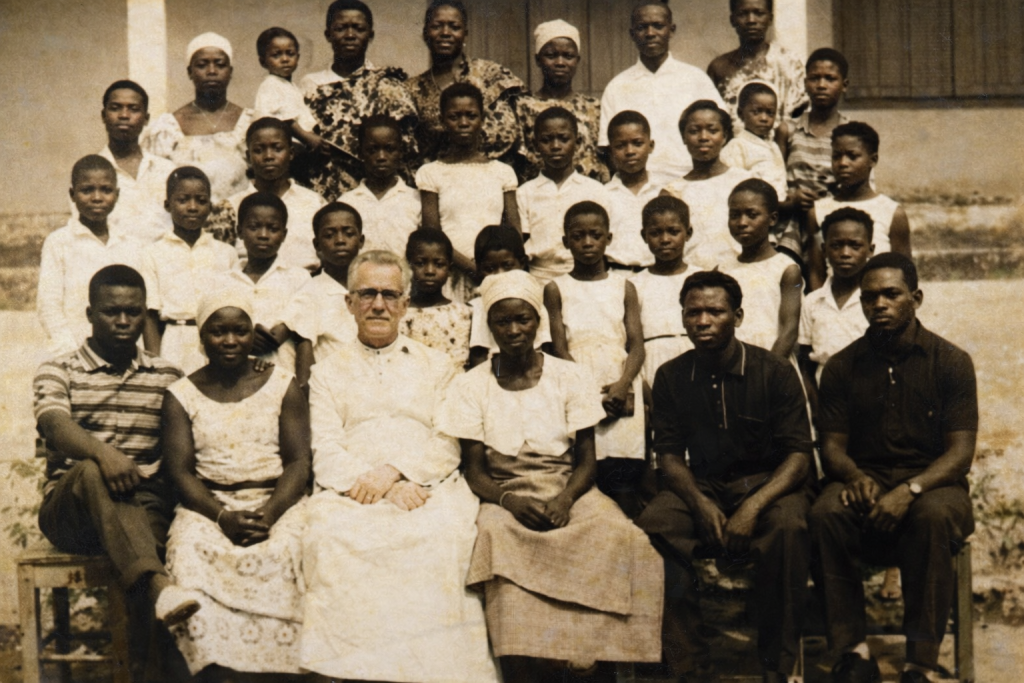
Between 1908 and 1919, several people from Ho-Dome were baptised into the Catholic Church, including Godfred Kodjo Deku, Johnson Bansah, Thomas Bansah, Anthony Anku Kuma, Francis Deku, Edward Ashun Koku, Augustine Kofi, and Dominic Appiah. These early converts formed the first Catholic community in Ho-Dome. However, due to the strong influence of the Evangelical Presbyterian Church in Dome, they had to attend Mass at Bankoe. To avoid tension and rivalry, Togbe Degbadzo advised them to worship with their fellow Catholics at Ho-Bankoe, where the Church was firmly established.
In 1939, the Catholic community in Ho-Dome made a determined attempt to establish a school, believing that education would support the growth of the Church by forming young people as teachers and catechists. Unfortunately, the school did not survive. The economic hardship following the First World War and local divisions linked to wider conflicts weakened the community. Despite these setbacks, the faith endured through the commitment of a small group of elderly Catholics.

After the Second World War, a renewed effort was made to establish a school. Messrs. Patrick Korsi Afari, Augustine Megbenu, and Herman Doku approached Mr. W. B. L. Adzie, then a Presbyterian, who generously offered rooms in his house for use as classrooms. He later converted to Catholicism. The first teachers were the late Francis Deku and Stephen Akpoh. Their salaries were paid by parents through a fee of two shillings per pupil, alongside an additional educational levy imposed on community members. This initiative led to steady growth in the number of Catholic converts in Ho-Dome.

In 1957, Torgbe Vondelinus Howusu Motte Kofi XI acquired land from the Dzaba family of Ho-Bankoe for the Church at Ho-Dome. A temporary shed was erected, and church activities resumed there. This brought relief to children and elderly members who had previously walked long distances to Bankoe for Mass.
Later, the late Rev. Monsignor Phillip S. Bonto, then parish priest of Sacred Heart Parish, recognized that the land acquired was insufficient for future development. In consultation with the late Patrick Afari, he approached the Glalah and Amexo families of Ho-Ahoe, who generously released additional adjoining land to the Church. This made it possible to construct permanent buildings for the primary and middle schools through communal labour. Building materials were provided by the Department of Social Welfare and Community Development with assistance from Mr. J. M. K. Addo. On 24 January 1960, church services were moved into the complete school building.
Special recognition is due to the elderly and catechists who faithfully sustained the community by leading services and preparing for priestly visits. The Catholic community also remains grateful to Mr. Patrick Korsi Afari and his wife for hosting visiting priests over the years.
Many priests continued to visit Ho-Dome regularly to celebrate Holy Mass, strengthening the faith community that had taken root through perseverance, sacrifice, and shared commitment.